
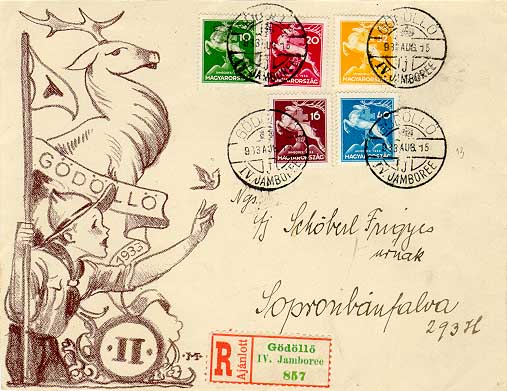
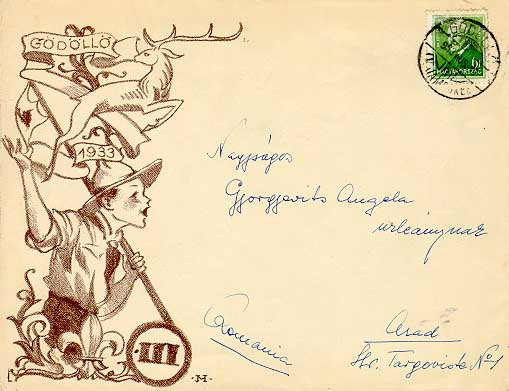
Type I
Type II
Type III
Philately of the Fourth World Boy Scout Jamboree
by Sheldon S. Levy
VI. THE CACHETS
A. The Official Cachets
|
|
|
Type I |
Type II |
Type III |
At least three types of apparently official cachets were produced by the Hungarian Boy Scouts Association and were employed on rather large envelopes (6 7/8 x 5 1/4"), mailed from the Jamboree. All are printed in brown ink and are copies of handsome sketches of combined Scouting and Jamboree motifs by an artist indicated only as "M", but who probably was the famous Hungarian Scout artist, Márton, who also sketched many drawings for picture post cards (see infra).
The different types are clearly enumerated by a Roman numeral appearing at the right hand side of each cachet.
Type I shows a Scout, holding a patrol flag in his right hand, with his left hand extended in welcome. Above him are two scrolls with legends reading "GÖDÖLLŐ" and "1933" and, atop the scrolls, an alert stag.
Type II has not been obtained, as yet, for reproduction, and the author would appreciate anyone having same to send him a copy of the cachet.
Type III has a Scout, apparently holding a patrol flag in his left hand, and with his right hand upraised. On this cachet, a leaping stag is pictured above the Scout, but between the Gödöllő scroll at the top and a smaller date scroll below.
B. The Air Mail Cachets
Although Budapest was only some eleven miles from the Jamboree site, a unique Scout air mail postal service was instituted between Gödöllő and the Mátyásföld air field, just outside of Budapest. At least some of the mail, both leaving and arriving at the Jamboree, although obviously not all of it, was handled by this circuitous and indirect method, for which there was a surcharge of 20 fillérs for letters and 10 fillérs for postcards. From the Mátyásföld airport, outgoing mail processed by way of regular air or surface mail to its ultimate destination.
The actual daily flights were made by a group of four Hungarian pilots, led by the country's flying ace, Frigyes Uefty, who had organized the Flying Scouts of Hungary and who had inspired the setting up of a special Flying Camp of Air Scouts, a few miles from the main Jamboree site and from which this air mail service was handled and flown. The Air Scouts themselves, in line with the European craze at the time, spent most of their time flying in some 16 gliders or sail planes, presumably when they were not helping to hand-stamp outgoing and incoming letters and postal cards with one of the variety of special air mail cachets.
One type of air mail cachet, semi-circular in design, pictured a fleur-de-lys and contained Hungarian wording meaning Scour air mail service, the legend "IV. JAMBOREE 1933 VIII 1-16" and, on outgoing mail, the wording 'GÖDÖLLŐ-BUDAPEST". This cachet was handstamped in brown ink and was used on air mail flown from the Jamboree to Mátyásföld airdrome. On incoming mail, a similar crescent-shaped cachet in blue ink was used, but on this one the fleur-de-lys was placed at the top of the design, the symbols "VIII 1-16" were omitted and the wording "BUDAPEST-GÖDÖLLŐ", instead of the reverse.
The second type of air mail cachet was circular in design with similar wording in a circle surrounding a combined line drawing of a monoplane and a leaping stag. The numerical dating, however, appeared only as "1933 VIII 1" on both of the cachets for incoming and outgoing mail. The prime differences between these Type II cachets used for air mail sent to and from the Jamboree were that, for incoming mail, the airplane and stag faced left and the cachet appeared in yellow, while for the outgoing mail, the airplane and stag faced right and green ink was used.
Below, an unusual sheet made unofficially by one of the Jamboree postmasters shows a variety of Jamboree postmarks (including a July 10th date, similar to the one appearing on the FDC shown previously); a special Jamboree label; and, particularly, examples of the Type I and II outgoing air mail cachets - Gödöllő to Budapest. Below it appears the incoming air mail cachets - Budapest to Gödöllő.
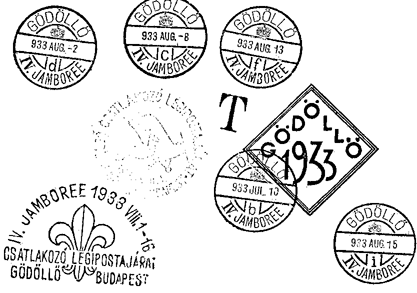
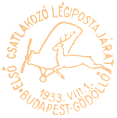
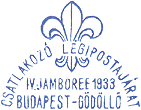
Previous reports concerning these four types of air mail cachets often mistakenly have referred to the crescent-shaped cachets in either brown or blue as for use on surface mail, and no prior account ever properly has designated what I believe to have been the actual purpose and use of the circular air mail cachets in green and yellow.
Initially, it seems clear, from a review of various covers and cards sent to and from the Jamboree, that all four cachets aforesaid were applied to both surface and air mail missives, but, correctly, only to those flown by the special Scout air mail service. No special cachet was regularly or properly affixed to letters and cards mailed through ordinary channels either to or from the Jamboree (although such erroneous examples do exist).
In addition, it is now my belief that the circular cachets were extra-special in that they were supposed to be applied on incoming and outgoing mail only on August 1, 1933 - the apparent official opening day of the Jamboree or of at least the air mail service. On the other hand, the crescent-shaped cachets were to be affixed by the air mail service on all dates thereafter through August 16, 1933 - the probable official termination date of the Jamboree or of the air mail service.
These opinions are confirmed by the fact that only the date "1933 VIII 1" appears on the circular cachets, while the legend "IV. JAMBOREE 1933 VIII 1-16" is shown on the brown crescent cachet. Moreover, all covers that I have seen with either of the circular cachets have been, in fact, dates August 1, 1933 (although it is not inconceivable that some "eager beaver" could have erroneously used a circular cachet on some subsequent date and the use of both cachets on one cover the day before, July 31, 1933, is known).
Accordingly, the previously mystery concerning the use of these particular cachets may now have been unraveled.
As to the crescent-shaped cachets, some cards, air mailed to the Jamboree, are known to contain examples of both the blue and brown air mail cachets thereon, although only the blue incoming cachet should have been applied. Close study of these items shows that they arrived at the Jamboree early in August, contained no return address and were not returned to the sender, as initially reported. In addition, cards mailed from the Jamboree have also been seen with both cachets, although only the brown one was proper. Moreover, at least one card mailed from Gödöllő through Mátyásföld Airfield to Prague, Czechoslovakia, and cancelled at Mátyásföld on August 1, 1933, also mistakenly shows the circular airmail cachet in yellow instead of green, so that other errors of combination and color are probable.
Eager Scout cancellers probably account for the extra cachets and for the mistakes, but who can blame them in the spirit of that great event.
Examples of some of the aforesaid appear on the opposite page and their rarity is unquestioned.
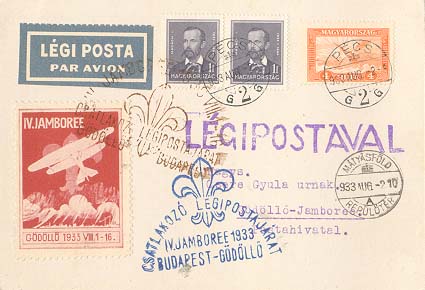


(2 images reduced)
C. The "Green Bar Bill" Cachet
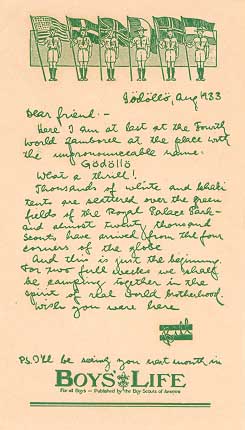
William Hillcourt, better known to readers of the Boy Scout publication, "Boys' Life", as "Green Bar Bill", and the official photographer for the
|
|
|
|
(Cachet) (Insert) Boy Scout of America Handbook, was one of the visitors to the 4th World Jamboree. To mark his visit and in conjunction with "Boys' Life", a group of special "Green Bar Bill" jamboree cacheted envelopes were produced, with an insert message from Bill, printed in green, and enclosed in each, and were sent, with various Jamboree stamps and postmarks, to friends of Bill Hillcourt and of "Boys' Life". The cachet itself, also printed in green and mostly on regulation size white envelopes, showed the outline of the Leaping White Stag with a Fleur de Lys at the lower left and the inscription: "From Green Bar Bill at the/ 1933/ JAMBOREE/ BUDAPEST-GÖDÖLLŐ/ AUGUST 2-15, 1933". |
D. The Troop and Group Cachets
Various troop or group cachets, usually hand-stamped in violet or black ink and appearing as one or two printed lines or in an oval shape around a Scout badge, are known to have been applied, probably indiscriminately, to various mail leaving the Jamboree. Such cachets emanated, at least, from Groups 140 and 250 and from Troop 2. (The post card showing the Danish Scout, infra, contains two of these cachets).
