
I recently spotted this Liberty series half-cent United States #1030 overprinted with the Boy Scouts emblem. How did this overprint come into being?
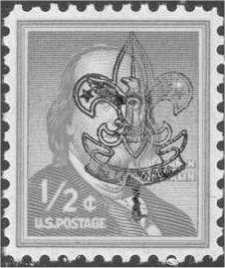
My first thought was perhaps a Scout Merit Badge Counselor or a stamp collector with an emblem rubber stamp printed the logo to give to young Scouts at a stamp show. A Scout could also have accomplished the same effect while visiting a stamp collecting merit badge promotion or exhibit at a Scout show.
The use of this half-cent stamp would be both an economic and historical promotion for stamp collecting, as Benjamin Franklin started the colonial postal service and was our first Postmaster. A topical overprint would not be sanctioned by the U.S. Postal Service, and invalidates the stamp for future postage. Precancels or perfins are the only alternations permitted to a U.S. issue.
My other thought was that of philatelic fraud. Too often today on the market, we see topical cachets applied using computers and ink jet printers to historic uncacheted first day covers. These modern topical covers may appeal to some collectors, and defraud others who do not know of their lineage.
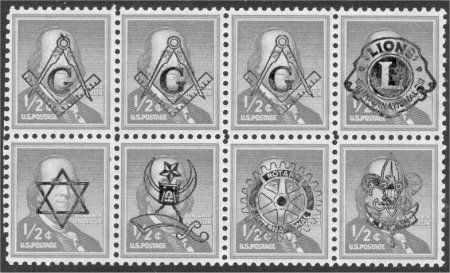
Identical overprinted #1030 mint-never-handled (MNH) stamps were offered at a recent eBay auction included topical overprints for the Rotary Club, Lions Club, Shriners, Masons, and the Star of David.
In follow-up, I received a reply from the seller of the overprinted block. He said he had purchased several of these stamps (#1030) in blocks of 8 with 3 the same and 5 other different (see picture above) from a dealer in Massachusetts around the early 1970s. He had said that a friend of his was fooling around with a printing press. MNH sheets of #1030 are inexpensive to acquire, yielding a great profit over cost. Concluding with my original question: is this a topical interest or a topical fraud? Only the collector can make that decision.